Why is solid wood furniture hard to find? A straight-talking guide for buyers who want the real thing
You’re not imagining it. If you’ve been searching for “wood furniture” and keep ending up with veneer, MDF, particleboard, flat-pack, or “wood effect”, it can feel like the industry is speaking in riddles. This is exactly why is solid wood furniture hard to find: the term “wood” often means “wood somewhere” rather than solid timber throughout. The good news is you can learn to spot the difference quickly—and once you do, buying a dining table (or any larger piece) becomes much less frustrating.
Why is solid wood furniture hard to find (and why veneer dominates)?
Solid timber is a slower, heavier, more expensive material to work with than engineered boards. That’s not a moral judgement—just the reality of modern manufacturing.
1) Cost and speed win in mass production
Most furniture is designed to hit a price point and be produced fast. Engineered boards (MDF, chipboard/particleboard) are inexpensive, consistent, and easy to machine. They also make it simpler to produce identical parts at scale.
2) Shipping and returns shape design
Flat-pack furniture is popular because it’s easier to warehouse and ship, and cheaper to return if something arrives damaged. Solid wood dining tables are heavier, bulkier, and more costly to transport—so fewer retailers take them on.
3) Consistency is easier with engineered materials
Real timber has knots, grain changes, natural colour variation, and movement. Those are the very things many of us love—but they’re harder to standardise across thousands of units. Veneer gives the “look of wood” with a more predictable finish.
4) Consumers are often steered by the word ‘wood’
Some listings lean on vague terms like “wood”, “solid wood frame”, or “real wood veneer”. None of those automatically mean solid wood throughout. This is a big reason behind real wood furniture availability feeling so limited: genuine timber pieces can be drowned out by broad, confusing language.
Why furniture is made from veneer (and when it’s not a bad thing)
Veneer isn’t automatically a scam. It’s a thin layer of real timber bonded to a stable core (often MDF or plywood). Done well, it can look beautiful and reduce the risk of warping on large surfaces.
That said, veneer becomes frustrating when it’s used to suggest a piece is “solid wood” when it isn’t—or when the core material is low quality.
Veneer can make sense when:
- You want a very wide, very uniform surface with minimal seasonal movement.
- The core is high quality and the construction is strong.
- The retailer is transparent about what’s veneered and what’s solid.
Veneer is more likely to disappoint when:
- The core is chipboard/particleboard and edges are simply banded.
- The veneer is very thin and prone to chipping.
- Repairs aren’t realistic once it’s damaged (you can’t sand a veneer the way you can solid timber).
If you’ve had a “wood” tabletop bubble near a radiator or chip at the corner after a year, you’ve already experienced why many buyers end up determined to find solid wood instead.
The language that misleads: how to read product descriptions like an expert
If you’ve felt misled, it’s often because furniture descriptions are written to sound reassuring while staying technically correct. Here’s how to decode them.
Look for the exact material in the main structure
For a dining table, that means the tabletop, legs, and apron/frame.
- “Solid wood”: Ask: solid wood where? Some items are solid legs with a veneered top.
- “Wood” or “wooden”: Too vague. Could mean anything from solid timber to MDF.
- “Engineered wood”: Usually MDF, particleboard, or a similar board.
- “Wood veneer”: Real timber on the surface, not solid throughout.
- “Rubberwood”, “acacia”, “mango”, “oak”: Species names are helpful only if the listing also says solid vs veneer.
Check for these tell-tale phrases
- “Solid wood frame” (often means the internal structure only)
- “Mixed materials” (fine, but you want clarity)
- “Wood effect” (not real wood)
Ask one simple question if it’s unclear
“Is the tabletop solid wood all the way through, or is it veneered/engineered?”
A good retailer should answer plainly.
Quick visual clues (not foolproof, but useful)
- A solid wood top often shows natural grain continuity and variation.
- Perfectly repeating grain patterns can indicate a printed finish or very uniform veneer.
- On table edges, a visible join line may suggest edge banding over a board core.
The goal isn’t to become suspicious of everything—it’s to become confident about what you’re actually paying for.
What to check before buying a solid wood dining table (so you don’t regret it)
A dining table is where solid wood really earns its keep: daily meals, hot mugs, homework, crafts, dinner parties, and the occasional “we’ll just put this down for a minute”. Here’s what matters.
1) Top thickness and construction
A substantial top tends to feel steadier and wears in better over time. If a listing doesn’t state thickness, it’s worth asking.
2) Joinery and stability
Solid wood should be built to handle real life. Look for:
- Sturdy leg fixings (not just a few small screws into soft board)
- A solid apron/frame under the top
- Bracing where needed for longer tables
3) Finish and maintenance expectations
No finish is “magic proof”. A well-finished solid wood table is practical, but you’ll still want to use coasters and wipe spills.
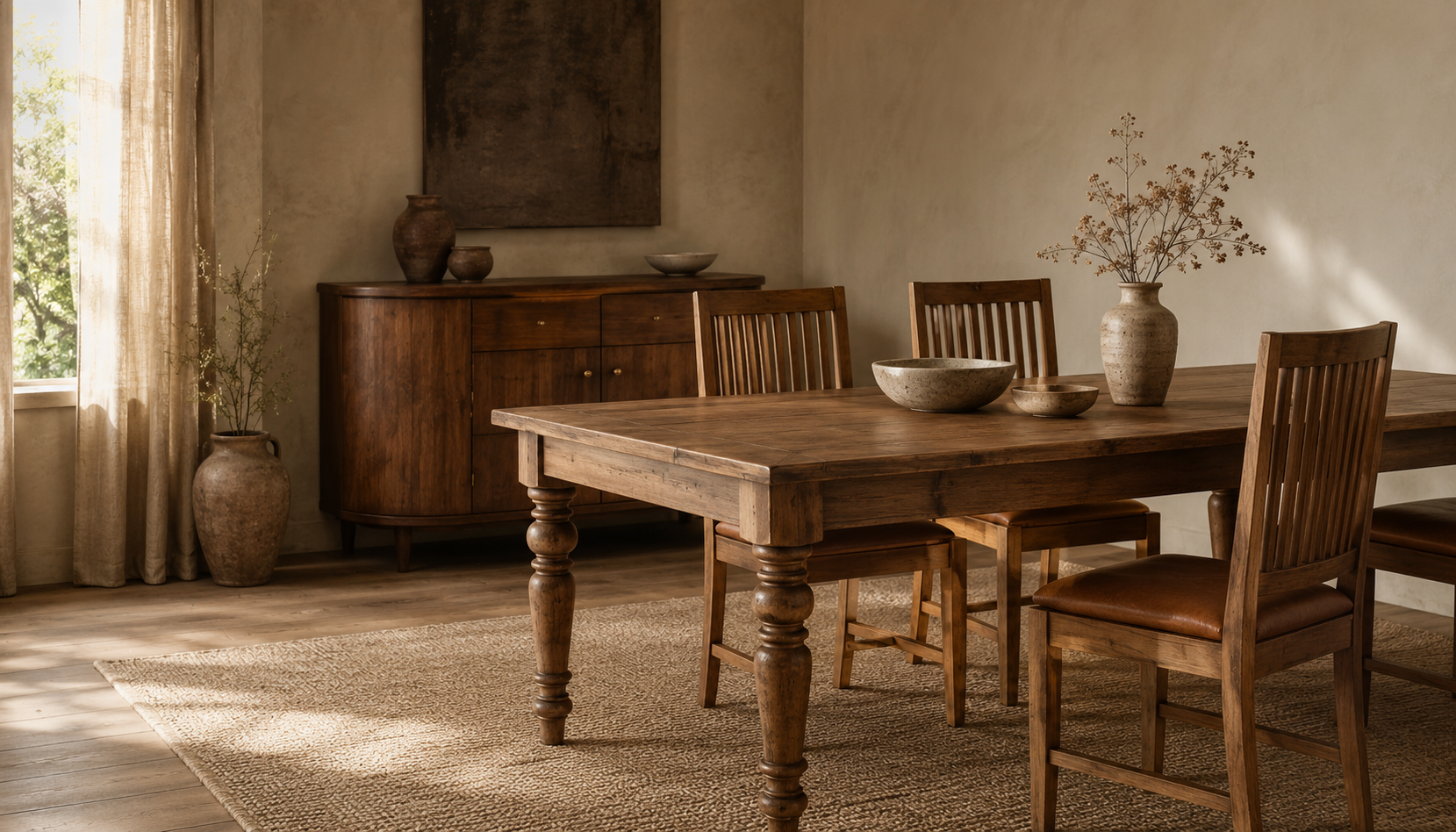
If you’re choosing solid mango wood, you’re likely doing it for warmth and character—the grain and natural variation look especially good in dining spaces with softer, lived-in styling.
4) Size in real rooms (UK reality check)
Before you commit, map it out with masking tape.
- Allow comfortable clearance around chairs so people can sit without shuffling sideways.
- Think about how you actually use the room: school bags, a high chair, a dog bed, a sideboard nearby.
A real-world example
In a typical open-plan kitchen-diner, a solid wood table becomes the “everything zone”: morning coffee, laptop sessions, and friends round on Friday. Solid timber holds up well to this sort of use because it can be refreshed over time, rather than simply replaced once the surface is damaged.
Solid wood in real life: durability, patina, and the ‘grown-up home’ feeling
People often describe solid wood furniture as feeling warmer or more “settled” in a room. That’s partly visual—grain, texture, and depth—but it’s also practical.
It has weight and presence
A well-made solid wood dining table doesn’t feel temporary. It anchors a space, especially in interiors that lean mid-century modern, Scandinavian, Japandi, rustic modern, or organic modern.
It ages in a way many people prefer
With solid timber, small marks and changes can become patina rather than damage that ruins the piece. You don’t need to aim for perfection; you can aim for a home that looks lived-in and cared for.
It’s easier to live with long-term
A veneered top can be hard to repair invisibly once it chips or lifts. Solid wood is often more forgiving because it can be maintained, and in some cases lightly sanded and refinished.
Styling tip: let the grain do some of the decorating
If you choose a characterful wood like mango, you can keep the rest calm:
- Pair with simple upholstered dining chairs in a neutral weave
- Add a textured runner or placemats rather than a full tablecloth
- Use warm metals (brass/blackened steel) and ceramics to echo the natural tone
This is the quiet advantage of real wood: it brings depth without needing lots of extra ‘stuff’.
How to buy solid wood with confidence (even when listings are vague)
If real wood furniture availability feels limited, a practical approach helps.
Step 1: Decide what must be solid
For many buyers, the must-have is a solid tabletop (because that’s where wear happens). Legs and frames matter too, but start with the surface you’ll live on every day.
Step 2: Ask for clear material breakdown
A trustworthy seller should be able to tell you exactly what’s solid and what isn’t.
Step 3: Look for cues of considered making
- Clear photography of edges, corners, and undersides
- Straightforward care guidance
- Specific material naming (not “wood” alone)
Step 4: Choose a wood that suits your lifestyle
If you love warmth and natural variation, solid mango wood is a strong choice for dining spaces—it has character, takes stains and finishes well, and suits both clean-lined and more rustic settings.
Step 5: Don’t ignore the ‘feel’ factor
A dining table is a daily-touch item. If you want your home to feel calmer, warmer, and more pulled together, solid wood can do a lot of heavy lifting—without shouting.
Conclusion
If you’ve been wondering why is solid wood furniture hard to find, it usually comes down to cost, shipping practicality, and confusing marketing language that blurs the line between solid timber and veneered boards. Once you know what to look for—clear material descriptions, sturdy construction, and honesty about what’s solid—you can shop with far more confidence.
If you’re ready to invest in a dining table that brings warmth, grain, and long-term value to your home, explore our handcrafted solid mango wood furniture collection.