Where Can I Get Solid Wood Furniture Without Being Misled? A Practical US Buying Guide
If you’ve been asking yourself “where can I get solid wood furniture” and actually trust what you’re buying, you’re definitely not alone. A lot of “wood” furniture sold online in the US is actually veneer over MDF, particleboard, plywood, or another engineered core. The product photos can look beautiful, but the descriptions are often vague enough to make shoppers second-guess everything.
That is where the frustration starts. You think you’re buying a substantial wooden dining table, but what arrives may feel lightweight, flat-packed, hollow, or less durable than expected. Edges can chip, surfaces can mark badly, and the piece may not have the natural warmth or weight you were hoping for.
The good news is that buying real solid wood furniture does not have to feel like a guessing game. You just need to know where to look, what wording to question, and which details separate genuine solid wood from convincing lookalikes.
This guide will walk you through where to get real wood furniture, how to shop with confidence, and what to ask before investing in a dining table or any other key piece for your home.
Why buying “real wood” furniture online can feel so confusing
Retailers are not always being deliberately misleading, but the language used in furniture listings can be slippery. Phrases like “wood look,” “wood finish,” “manufactured wood,” “engineered wood,” “real wood veneer,” and “solid wood frame” can all sound reassuring, even when the main surfaces are not solid wood.
For example, a dining table might be described as having an “oak finish” and “solid wood legs.” That may mean the legs are solid, but the tabletop—the part that takes the most daily wear—is made from veneer over MDF or particleboard.
Veneer is not automatically bad. Some veneer furniture is well-made and attractive. But it is not the same as a solid wood tabletop that has natural depth, character, and long-term repairability.
If you feel overwhelmed by major furniture websites, online marketplaces, and thousands of listings that all look similar, you are not doing anything wrong. You simply need a clearer way to filter your options.
Where can I get solid wood furniture? Start with these retailer types
If your priority is a dining table that feels substantial, looks warm, and lasts for years, these are the most reliable places to begin your search.
1. Specialist solid wood furniture retailers
Specialist solid wood furniture retailers are usually one of the best places to start. These are brands whose collections are built around real wood furniture, not stores that occasionally carry a “wood” range alongside lots of engineered or flat-pack pieces.
A good specialist retailer will usually be more specific about:
- the wood species
- whether the main surfaces are solid wood
- the finish used
- the construction method
- natural grain variation
- care instructions
This is especially important when buying a dining table. You want to know whether the tabletop is solid wood all the way through, not just whether the legs or frame are solid.
2. Independent makers and workshops
Independent furniture makers and small workshops can be a brilliant option if you want something handcrafted, characterful, or made with more attention to detail.
The benefit is transparency. Smaller makers often know exactly where their wood comes from, how thick the tabletop is, how the piece is joined, and what finish has been applied.
The trade-off may be longer lead times, higher prices, or more variation between pieces. For many homeowners, that is part of the appeal. You are not buying a mass-produced placeholder. You are choosing something with more individuality and permanence.
3. Local furniture showrooms
Local furniture stores and showrooms are useful because you can inspect pieces in person. This can make it much easier to understand the difference between solid wood, veneer, and engineered wood.
In a showroom, you can:
- feel the weight of a dining table
- check the edge profile
- look underneath the tabletop
- see how the grain moves across the surface
- ask staff direct questions
- compare finishes in natural light
This can be especially helpful if you are choosing a dining table for a busy household, open-plan kitchen, or formal dining space.
4. Transparent online-only furniture brands
Some online-only furniture retailers do a very good job of explaining their materials clearly. You do not always need to see a piece in person if the product page gives you enough useful detail.
Look for listings that include:
- close-up photos of the grain
- edge and corner shots
- clear material specifications
- information about the finish
- dimensions and weight
- care guidance
- honest notes about natural variation
If an online retailer can clearly explain what the product is made from, how it is finished, and how to care for it, that is usually a good sign.
5. Online marketplaces, but with caution
Marketplaces can include excellent sellers, vintage finds, and handcrafted furniture, but they are also where vague listings thrive. One seller may be very transparent, while another may use confusing phrases like “wood look,” “oak effect,” or “solid wood style” without explaining the actual material.
If you are shopping on a marketplace, do not assume anything. Message the seller and ask direct questions before buying. If they cannot confirm whether the tabletop or main surface is solid wood, it is safer to keep looking.
A quick checklist to confirm it is truly solid wood
Before buying any dining table, sideboard, dresser, or coffee table, use this checklist to check whether you are looking at genuine solid wood or a wood-look alternative.
Look for “solid wood” stated for the main surface
For a dining table, this means the tabletop. For a dresser, it means the drawer fronts and body. For a sideboard, it means the top, doors, and frame.
If the listing only says “solid wood legs” or “solid wood frame,” that does not necessarily mean the whole piece is solid wood.
Check the wood species
A trustworthy product description should usually tell you what type of wood has been used. For example:
- solid mango wood
- solid oak
- solid walnut
- solid acacia
- solid pine
If the description only says “wood,” “wood finish,” or “natural wood look,” ask for clarification.
Look for construction details
Good retailers often mention thickness, joinery, planked construction, or how the piece is assembled. You do not need to know every technical term, but you do want signs that the retailer understands the product beyond styling language.
Study the photos closely
Look for close-up images of:
- the tabletop edge
- corners
- underside
- grain pattern
- joints
- surface finish
If every photo is heavily styled from far away, it is harder to judge what you are actually buying.
Look for honest notes about natural variation
Real wood has grain movement, tonal changes, knots, lines, and character. A good retailer will usually explain that each piece may vary slightly because natural wood is not perfectly uniform.
That is not a flaw. It is part of what makes solid wood furniture feel warm and individual.
Red flags to watch for when buying wood furniture
Be cautious if a listing uses phrases like:
- wood look
- oak look
- walnut effect
- wood effect
- wood finish
- manufactured wood
- engineered wood
- MDF
- particleboard
- real wood veneer
- solid wood frame only
- solid wood legs
Again, these materials are not always bad. The issue is whether the listing makes them clear. If you are specifically looking for solid wood furniture, you need the retailer to be precise about what is solid and what is not.
The three questions to ask any retailer before you buy
Whether you are shopping from a specialist brand, a large retailer, a local showroom, or a marketplace seller, these three questions will quickly tell you how transparent they are.
1. Is the tabletop 100% solid wood all the way through?
This is the most important question when buying a dining table.
You want a clear answer such as:
“Yes, the tabletop is solid mango wood.”
Be cautious if the answer only says:
“It has a real wood finish,”
“It has a wood veneer,”
“The frame is solid wood,”
or “It has a natural wood look.”
Those answers do not confirm that the main surface is solid.
2. What is underneath the surface?
If the piece is veneer, ask what the veneer is applied to. It could be MDF, particleboard, plywood, or another engineered material.
This matters because the core affects weight, durability, repairability, and how the piece behaves over time.
3. How is it finished?
The finish affects daily use. Ask whether the table is oiled, lacquered, waxed, stained, or sealed.
A good retailer should be able to explain how the finish handles everyday life, including spills, wiping, water rings, and heat. Coasters and placemats are still sensible, but you should know what kind of care the surface needs before you buy.
Choosing a solid wood dining table that suits real life
A dining table is not just there to look good in a photo. It is one of the hardest-working pieces of furniture in the home. The best solid wood dining table should suit how you actually live.
For family meals and homework
If your table will be used for schoolwork, laptops, snacks, crafts, and everyday meals, choose something sturdy with enough surface area for real life. A solid wood table can bring a sense of permanence to a busy family space.
For smaller homes and apartments
Pay close attention to leg placement. A table might look generous online, but if the legs sit awkwardly, chairs may not tuck in properly. Round tables can work beautifully in smaller dining spaces because they soften the room and make movement easier.
For open-plan living
A solid wood dining table can help anchor an open-plan kitchen or living area. Natural grain adds warmth and texture, especially alongside simple cabinetry, neutral walls, or modern flooring.
For hosting
If you often have friends or family over, think about comfort as much as style. Check whether chairs fit neatly around the table and whether anyone sitting at the end will be blocked by table legs.
Why solid mango wood is a strong choice
Solid mango wood is a popular choice for dining tables because it offers warmth, strength, and character without feeling overly formal. Its grain can be beautifully expressive, with natural variation that makes each piece feel individual.
It works particularly well with interiors such as:
- modern rustic
- Japandi
- Scandinavian
- mid-century modern
- organic modern
- farmhouse-inspired spaces
If you want a dining table that feels substantial but not heavy-looking, solid mango wood can be a lovely middle ground. It brings natural texture into the room while still feeling clean and versatile.
How to spot quality craftsmanship
Even when a piece is made from solid wood, build quality still matters. Here are the details that often separate a lasting piece from a short-term one.
Stable proportions
A well-made dining table should feel balanced. It should not wobble, rack, or feel too top-heavy. The base needs to properly support the tabletop.
Thoughtful edges and corners
Edges matter because they are touched and knocked every day. A nicely finished edge feels better under your hands and helps the piece look refined over time.
Consistent finish
The finish should look even and intentional. It should enhance the wood grain rather than covering it with a thick, plasticky surface.
Simple, considered detailing
Quality craftsmanship does not always need to shout. Clean lines, tidy joins, balanced proportions, and well-matched grain can make a piece feel quietly elevated.
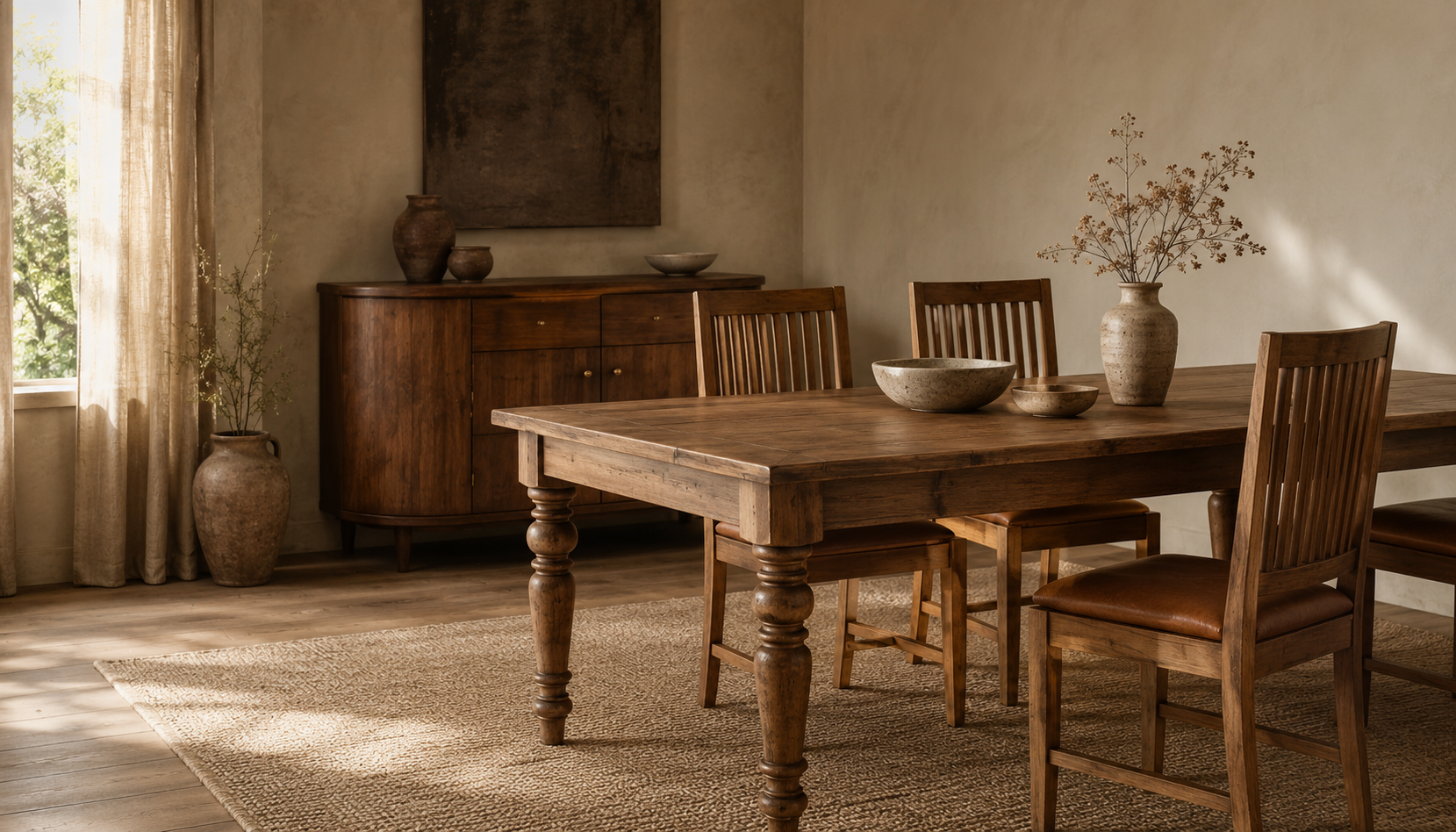
Imagine a warm neutral dining room with linen curtains, a textured rug, simple ceramic lighting, and a solid wood dining table at the center. The table becomes the grounding piece. It makes the room feel finished, intentional, and lived in.
A simple way to shop online with confidence
If you are buying online, this process will help you stay focused and avoid getting overwhelmed.
1. Shortlist 3–5 tables you genuinely like
Start with the practical things first: size, shape, color, and style. Do not get lost in endless scrolling.
2. Check the materials
Confirm whether the tabletop is solid wood. If the listing does not say, ask.
3. Inspect the photos
Zoom in on the edges, corners, underside, legs, and grain. If there are no close-ups, request more images.
4. Ask the three key questions
A retailer’s response tells you a lot. Clear, confident answers build trust. Vague replies are a sign to be careful.
5. Match the table to your lifestyle
Think about kids, pets, hosting, cleaning, everyday meals, and how much wear the table will get. The right table is not just the one that looks best online. It is the one that works beautifully in your home.
Final thoughts
If you have been wondering where can I get solid wood furniture without being misled, the answer is to shop with retailers who are specific, transparent, and confident about what they sell.
Look for clear material descriptions, solid wood stated for the main surfaces, detailed photography, honest notes about natural variation, and practical care advice. Be cautious with vague phrases like “wood look,” “wood finish,” “manufactured wood,” “real wood veneer,” or “solid wood frame” unless the retailer explains exactly what is solid and what is not.
Once you know what to look for, buying solid wood furniture becomes much easier. You are no longer relying on styled photos or vague product names. You are choosing pieces based on material, craftsmanship, and how they will feel in your home for years to come.
If you are ready to focus your search on warm, characterful pieces made to be lived with, explore the handcrafted solid mango wood furniture collection at Grain and Loom, starting with our dining tables and building out your space from there.