What furniture brands use solid wood? A practical guide to spotting the real thing
If you’ve ever bought a “wood” table that arrived feeling oddly light, sounded hollow when you tapped it, or started chipping at the edges within months, you’re not alone. The frustrating part is that lots of brands use reassuring language—“crafted”, “timber”, “natural”, “wood finish”—without clearly saying what the piece is actually made from.
So if you’re googling what furniture brands use solid wood, the real question is: how do you quickly separate brands that build with proper timber from those relying on veneer, MDF, particleboard, or “wood effect” surfaces? This guide breaks down what to look for, what to ask, and how to buy with confidence—especially if you’re shopping for a dining table that needs to cope with real life.
Why it’s so hard to tell who uses solid wood (and why it matters)
Furniture descriptions can be slippery because there’s no single, standard way brands must describe materials on product pages. One brand might say “oak” and mean solid oak throughout; another might mean “oak veneer over engineered wood”. Both can look similar in photos.
It matters because the material affects how a piece feels and how it lives in your home:
- Weight and stability: Solid wood pieces tend to feel more grounded and less “tinny” or wobbly.
- Edge durability: Veneer and foil wraps are most vulnerable on corners and edges—exactly where chairs knock and kids’ toys scrape.
- Refinishing potential: Solid wood can often be lightly sanded and refreshed over time, whereas a thin veneer can be much less forgiving.
- Character over time: Real timber develops a lived-in patina. Grain variation is part of the warmth people are chasing when they move on from flat-pack.
None of this means veneer is always “bad”—a good veneer on stable cores has its place—but if you specifically want brands that make real wood furniture, you need to know what you’re paying for.
What “solid wood” should mean (and the common terms that muddy the waters)
A genuinely solid wood piece uses real timber for the main structure—typically the top, legs, and rails—rather than a thin layer applied to a different core. But the grey areas come from marketing terms. Here’s a quick translation guide you can use while browsing:
- Solid wood / solid timber: The main components are wood, not a veneer surface over MDF/particleboard.
- Veneer: A thin slice of real wood bonded to another material (often MDF). Can look beautiful, but edges and wear points are the weak spots.
- Engineered wood: A broad umbrella term that can include plywood, MDF, chipboard, or composites.
- MDF / particleboard / chipboard: Man-made boards. Often stable and cost-effective, but prone to swelling if water gets in, and edges can chip.
- Wood effect / wood look: Not real wood at the surface—usually a printed laminate.
- Rubberwood, acacia, mango, oak, ash, walnut: These are *species*. The key is whether the listing says solid (and where).
If a product page doesn’t state “solid” anywhere, assume it isn’t—then verify before you buy.
What furniture brands use solid wood? The fastest ways to check before you buy
You don’t need to become a materials expert—just ask the right questions and look for a few tells.
1) Look for an explicit materials breakdown (not just a headline).
A trustworthy listing usually spells it out clearly, for example: “Solid wood top, solid wood legs,” or “Solid mango wood frame.” If it only says “wood”, “timber”, or “natural finish”, that’s not enough.
2) Check the “Specifications” section for the words veneer, MDF, engineered wood.
Good brands will disclose these. If you find them, decide whether you’re comfortable with it. A solid wood base with a veneered panel is different from a veneered top (your most-used surface).
3) Ask one direct question (and see how they respond).
Message customer service and ask:
- “Is the tabletop solid wood all the way through, or is it veneer over MDF/engineered wood?”
A clear brand will answer clearly. Vague answers (“high-quality wood materials”) are a red flag.
4) Look at edge and underside photos.
- Veneer often shows a very uniform, repeated grain on the top surface.
- Undersides sometimes reveal joining methods or the core material.
- A solid wood top may show natural variation and joins that make sense structurally.
5) Check weight and construction details.
Brands selling solid wood pieces usually aren’t shy about joinery, thickness, and build. If the table is surprisingly light for its size, it may not be solid.
These checks won’t name-and-shame specific retailers, but they will help you identify solid wood furniture brands by the way they describe—and stand behind—their materials.
Solid wood vs veneer vs MDF: which is best for a busy dining table?
Dining tables have one job: handle daily life. Think hot mugs, wiped-down spills, homework, elbows, the occasional dropped fork.
Solid wood dining tables
- Best for: People who want warmth, longevity, and a table that can age gracefully.
- Why it works: Solid wood feels substantial and can often be refreshed with careful maintenance.
- What to accept: Natural grain variation, knots, and subtle movement with seasons (expansion/contraction is normal in real timber).
Veneer-topped tables
- Best for: A more uniform look, sometimes at a lower cost.
- Why it works: Good veneers can be stable and attractive.
- Watch-outs: Once the surface is damaged, repair options can be limited; edges are vulnerable.
MDF/particleboard with a wood-effect finish
- Best for: Short-term solutions or low-commitment spaces.
- Watch-outs: Chips, swelling, and a “temporary” feel are common complaints—especially around table edges.
A practical way to decide: if you’re buying a “forever-ish” dining table—one you’ll move house with, host around, and keep for years—solid wood tends to deliver the most satisfaction day to day.
Why mango wood is a smart solid-wood choice for real homes
Not all solid woods feel the same in a room. Mango wood is popular in modern interiors because it brings warmth without feeling heavy or traditional.
Here’s why it works particularly well for dining tables:
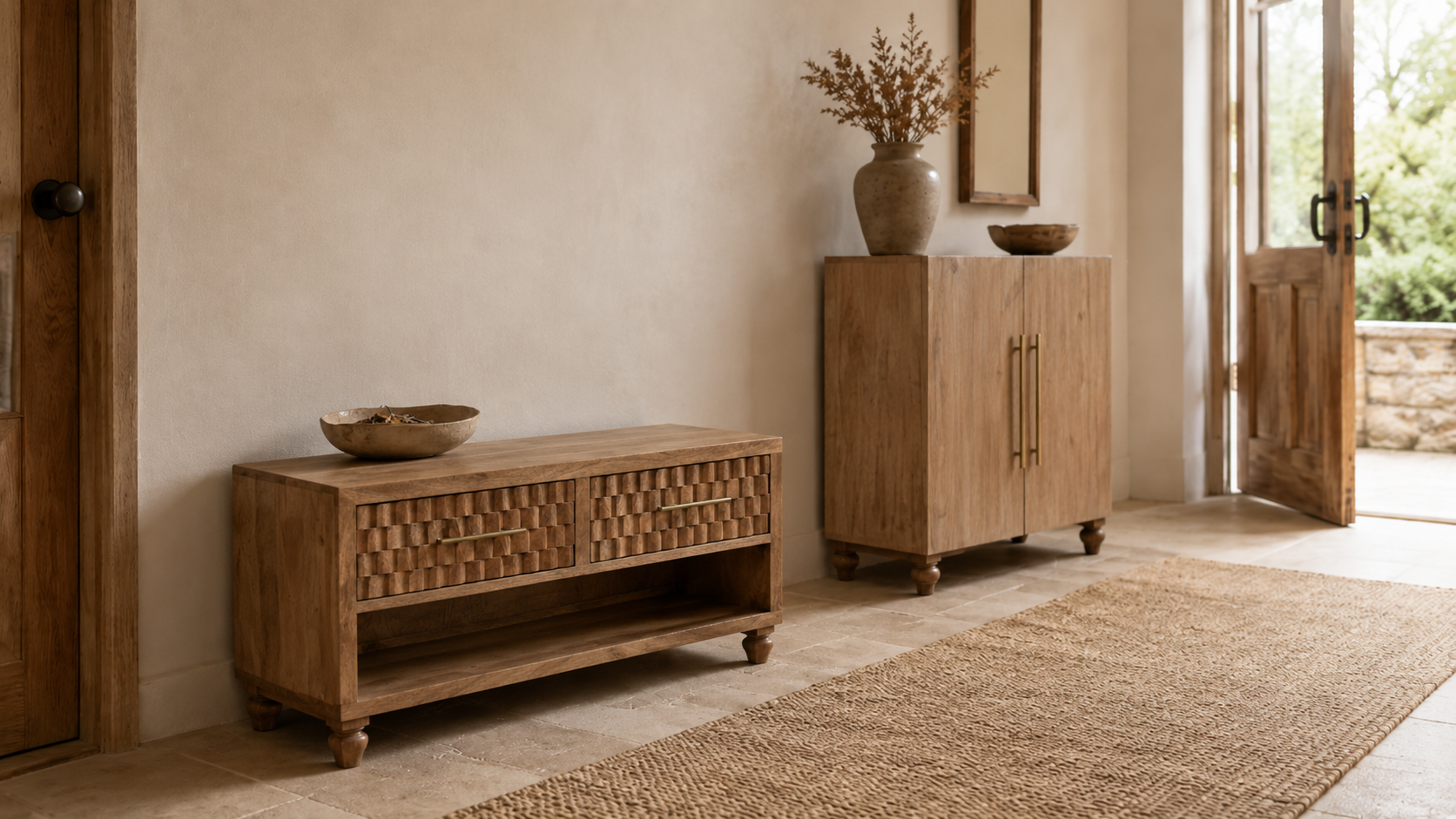
- Characterful grain: Mango wood has visible grain and natural variation that adds depth—helpful if you’re trying to avoid that flat, printed look.
- A warm tone: It sits beautifully with soft whites, warm greys, earthy neutrals, and black accents.
- Grown-up, relaxed feel: It suits mid-century modern silhouettes, Scandinavian simplicity, rustic modern textures, and the calmer lines of Japandi.
Real-life styling examples:
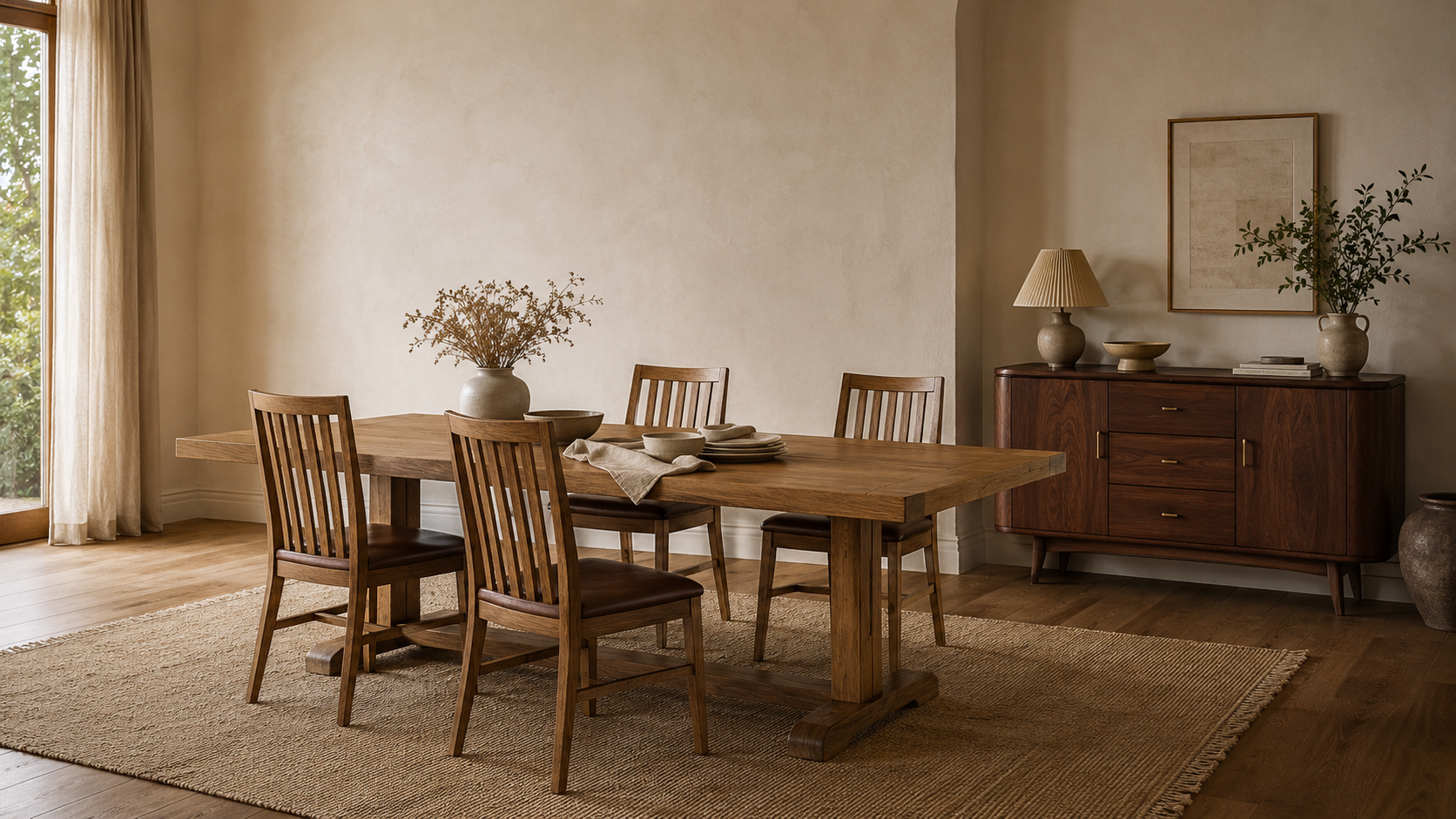
- Open-plan kitchen-diner: A solid mango wood dining table can soften a sleek kitchen (especially with stone-look worktops and matte cabinetry). Pair it with simple upholstered chairs and a linen runner.
- Period terrace dining room: Mango’s warmth balances painted walls and original floors. Add a low pendant and a mix of chair styles for a collected look.
- Busy family space: A robust solid wood surface feels less precious. Keep coasters in a small tray, and choose chairs that wipe clean.
If you like furniture that feels lived-in rather than showroom-perfect, solid mango wood is a genuinely practical choice.
Buying checklist: how to choose a solid wood dining table you won’t regret
Once you’ve found solid wood furniture brands you trust, the next step is choosing the right piece.
1) Get the proportions right (not just the length).
- Leave breathing space: ideally around 90cm between the table edge and walls/radiators so chairs pull out comfortably.
- Consider leg placement: corner legs can steal chair space; a central base can be more flexible.
2) Think through your “daily set-up”.
- Do you eat at the table every night?
- Is it also a work-from-home spot?
- Do you need it to handle crafts, puzzles, or kids’ projects?
A table that looks great but doesn’t suit your routines will annoy you fast.
3) Match chairs to your lifestyle (and your table height).
Dining chairs are where comfort lives. If you host, consider a mix: supportive end chairs, simpler side chairs.
4) Expect natural variation—and learn what’s normal.
With real wood, small differences in tone and grain are part of the appeal. What you want to avoid is unclear finishing information or vague material claims.
5) Prioritise build clarity.
Look for brands that tell you what the table is made from, how it’s finished, and how to care for it—without making you hunt for answers.
Conclusion
If you’re trying to work out what furniture brands use solid wood, the most reliable approach is to ignore the glossy wording and focus on specifics: an honest materials breakdown, clear answers to direct questions, and construction details that match how you actually live.
If you’re ready to bring that warmth and longevity into your home, Grain and Loom makes solid mango wood pieces designed to feel substantial, calm, and characterful in everyday spaces. Explore our handcrafted solid mango wood furniture collection—starting with our dining tables, and build a dining area that feels properly settled, not temporary.